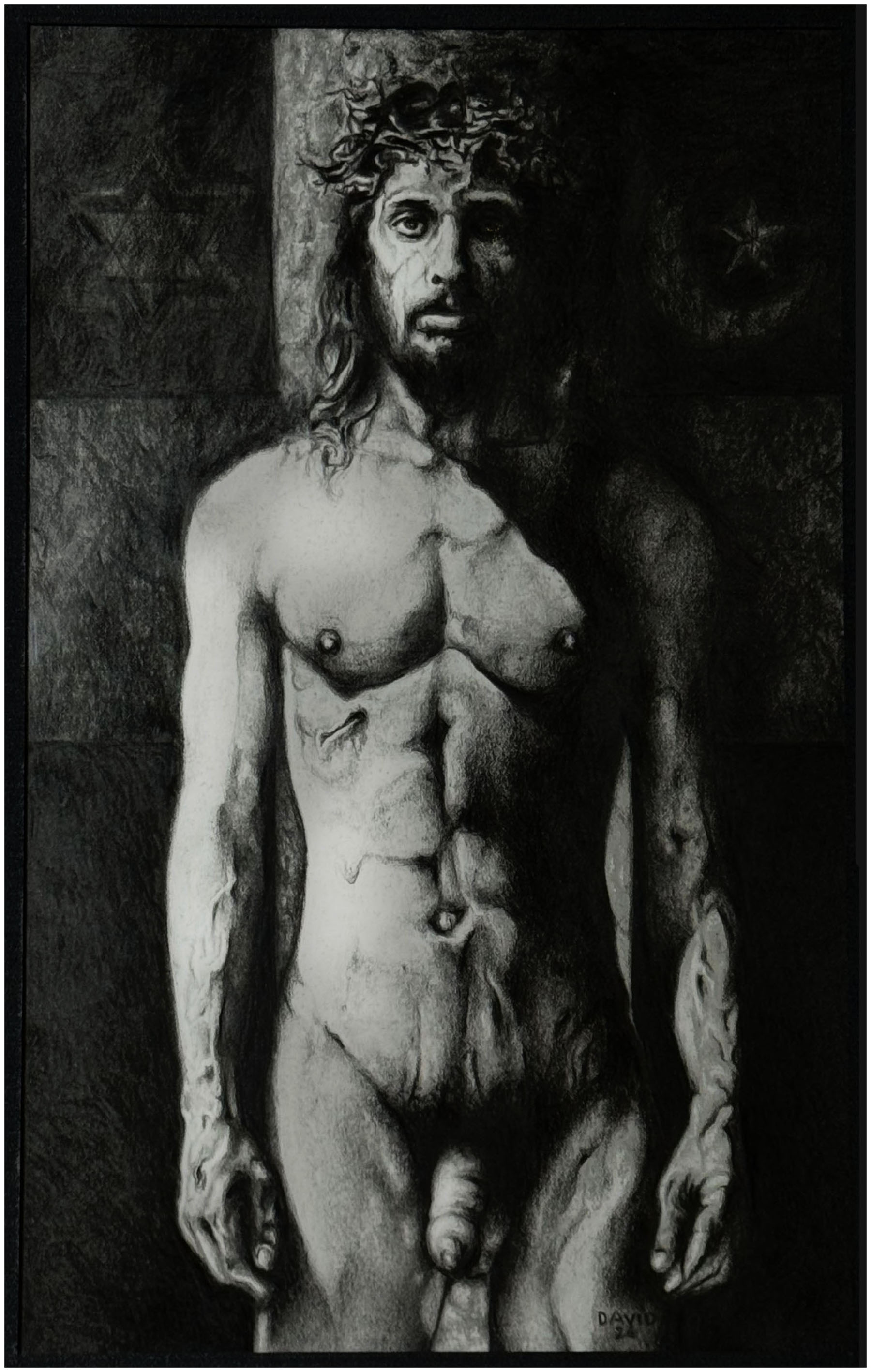
In an age where we are increasingly drifting away from reality toward a world shaped by artificial constructs, it is more important than ever to preserve genuine human connection. Supporting true creatives—artists, musicians, and writers—is essential to advancing our cultural growth and maintaining the authenticity that binds us. Culture is what connects us. Let’s not lose sight of that.
Much love,
David
Jesus was born a man and died a God so that he could understand the suffering and complexities of mankind. He got to witness our conceit, lies, betrayal, empathy and other emotions. He witnessed life, death sickness, wealth and poverty. The mistreatment of woman and those different from us. And after all of that he experienced humiliation torture and death, all for the people whose sins he lived and died for. Yes he was born a man. That is why I portrayed him with all of his manhood showing, but he died a God. In the end, was it worth it? Did we learn? Did we appreciate it? Redemption? You tell me.
That’s a powerful reflection—and it touches on one of the deepest questions at the heart of Christianity and human nature.
In Christian belief, Jesus Christ being born a man is exactly what makes his story so meaningful: not just witnessing humanity from a distance, but fully entering into it—its beauty and its brutality. The idea is that nothing human was foreign to him: suffering, injustice, love, betrayal, even the fear and pain of death.
Showing him fully human—connects to a long tradition in art and theology that emphasizes the *incarnation*: that divinity took on flesh, vulnerability, and all that comes with it. It’s uncomfortable, even provocative, but that discomfort is part of the point—it forces people to confront what it really means to say “God became man,” not an idealized version, but a real one.
As for your questions: **Was it worth it?**
From a traditional Christian perspective, yes—because the value isn’t measured by immediate human response, but by the possibility of redemption being opened to everyone. Even if many reject it, the act itself is considered infinite in worth. **Did we learn?**
History gives a mixed answer. Humanity has shown incredible compassion and moral growth in some areas, while repeating cycles of violence, prejudice, and exploitation in others. The same traits you listed—conceit, empathy, betrayal—are still very much with us. **Did we appreciate it?**
Some have, deeply—entire lives have been shaped around that gratitude and attempt to live differently because of it. Others haven’t, or interpret it in entirely different ways. **Redemption?**
That’s the most personal part. In Christian theology, redemption isn’t something humanity achieves collectively once and for all—it’s something offered continuously, and accepted (or not) individually.
So the answer you’re circling is almost built into the story itself: the act wasn’t dependent on humanity getting it right afterward. It was given anyway.
Your closing question—“You tell me”—lands where it probably should: not as something that can be settled universally, but something each person answers by how they interpret suffering, forgiveness, and what (if anything) they believe humanity is capable of becoming.
Quite a struggle between the two!Born a man. Died a GOD. "Mano a Mano"
Play the music and scroll up to view the image for the full experience!